Full-Body Strength Training: A Coached Plan to Get Stronger
Build full-body strength with the movement patterns, sets, reps and rest the research supports, plus how coaching scales it for beginners, over 40 and 60+.
Full-Body Strength Training: A Coached Plan to Get Stronger
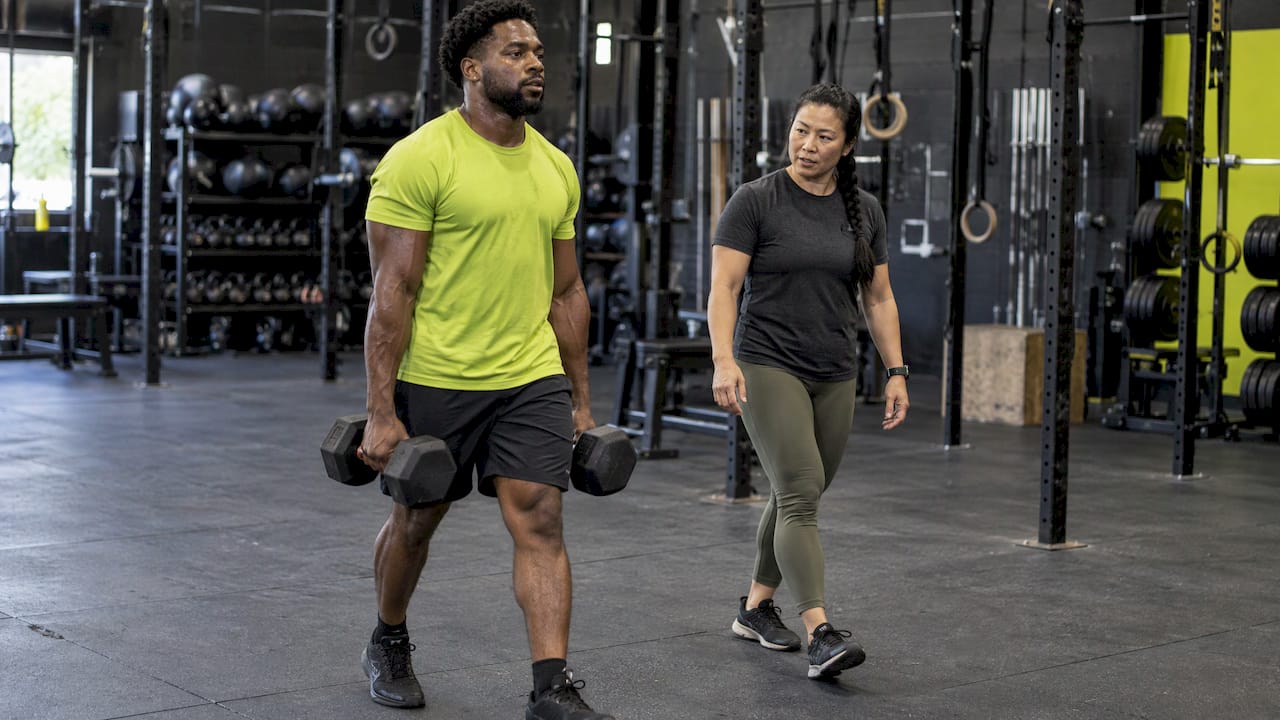
A good full-body strength workout trains every major muscle group in one session, using a handful of basic movements, two to three times a week. You squat, hinge, push, pull and carry, rest a day or two between sessions, and add weight slowly. The plan is simple. What stops most people is doing it consistently and with good form, which is why many Frederick adults who drifted away from a big-box gym do better in a coached class. At Odin CrossFit in downtown Frederick, every class is led by a credentialed coach who teaches the movements, corrects form and scales the workout to you.
This guide gives you the plan itself: what a full-body session covers, how often to train, a sample workout, how to scale it at any age, and how to progress without getting hurt.
TL;DR
- Cover six movement patterns in every session: squat, hip hinge, push, pull, core and carry.
- Train each major muscle group at least two days a week, with a day or two of rest between sessions.
- Beginners do well on 1 to 3 sets of 8 to 12 repetitions, with a weight that makes the last reps hard but controlled.
- Scale by load, range of motion and tempo, not by skipping movements. Adults over 40 and 60 and older follow the same pattern with lighter starts.
- Coaching makes the plan stick: someone teaches the lifts, adjusts the weights and notices when you miss a class.
Table of Contents
- What full-body strength training actually covers
- How often, how many reps, how much rest
- A sample full-body session for a beginner
- Scaling full-body strength for your age and experience
- How to progress without overreaching
- Safety checks before you begin
- Full body or a split routine?
- Why a coached class beats a plan on your phone
- Start strength training at Odin CrossFit
- Our view on full-body strength
- FAQ
- Sources
What full-body strength training actually covers
“Full body” means more than a mix of arm and leg exercises. Mayo Clinic lists the major muscle groups a strength program should reach as the shoulders, arms, chest, abdomen, back, hips and legs.
The easier way to plan is by movement pattern, a basic way the body moves that many exercises share. The National Strength and Conditioning Association names six fundamental patterns:
- Squat (knee-dominant): squats, lunges, leg press.
- Hip hinge (hip-dominant): deadlift, Romanian deadlift.
- Horizontal push: bench press, push-up.
- Horizontal pull: rows.
- Vertical push: overhead press.
- Vertical pull: pull-up, pulldown.
An exercise-science article from Adelphi University frames it slightly differently: at least one exercise each for upper-body push, upper-body pull, lower-body push, lower-body pull or hinge, core stability and locomotion, meaning weighted carries such as farmer’s walks. The University of Washington’s Whole U guide likewise recommends a balanced routine covering push, pull, hinge, squat and carry.
Put together, a complete session has a squat, a hinge, a push, a pull, something for the trunk and a carry. If one is missing, you leave a gap in your strength that shows up later, usually as a sore lower back or a weak shoulder.
How often, how many reps, how much rest
The numbers are consistent across the major guidelines, which makes the plan easy to follow.
- Frequency: The Physical Activity Guidelines for Americans call for muscle-strengthening activity for all major muscle groups at least two days a week. The ACSM 2011 position stand recommends training each major muscle group two to three days a week.
- Recovery: Leave at least 48 hours before working the same muscle group again, according to the same ACSM position stand. In practice that means Monday, Wednesday, Friday or Tuesday, Thursday, with a weekend day free.
- Sets and reps: The federal guidelines say one set of 8 to 12 repetitions is effective, and 2 to 3 sets may be more effective. Each set should reach the point where another repetition would be difficult.
- Rest between sets: ACSM suggests 2 to 3 minutes for strength work. This feels long the first time. It is what lets you lift well on the next set.
Mayo Clinic describes the right weight as one heavy enough to tire the muscle after about 12 to 15 repetitions, and says to stop any exercise that causes pain. Tired and sore the next day is normal. Sharp or joint pain is a signal to stop.
A sample full-body session for a beginner
The American Cancer Society, drawing on ACSM and CDC guidance, lays out a Tuesday and Thursday full-body schedule built from push-ups, bent-over rows, shoulder presses, squats, reverse lunges, deadlifts, bird-dogs and dead-bugs, after a 5 to 10 minute warm-up. Here is a session in the same spirit, organized by movement pattern.
| Pattern | Exercise | Beginner dose |
|---|---|---|
| Warm-up | Easy movement, hip and shoulder mobility | 5 to 10 minutes |
| Squat | Goblet squat or box squat | 2 sets of 8 to 12 |
| Hip hinge | Romanian deadlift with dumbbells | 2 sets of 8 to 12 |
| Horizontal push | Push-up (incline if needed) | 2 sets of 8 to 12 |
| Horizontal pull | Dumbbell or barbell row | 2 sets of 8 to 12 |
| Vertical push | Dumbbell shoulder press | 2 sets of 8 to 12 |
| Core | Dead-bug or bird-dog | 2 sets of 6 to 10 per side |
| Carry | Farmer’s walk | 2 to 3 trips of 30 to 40 steps |
This takes about 45 minutes with warm-up and rest. Rest 2 to 3 minutes between hard sets, and use that time to set up the next exercise.
Two details matter more than the exercise list. First, choose a weight you can lift with control. The VA’s MOVE! beginner handout suggests a slow 3-1-3 tempo: three seconds up, a one-second hold, three seconds down. Second, when you can lift the load more than 12 times, it is time to go heavier.
Where beginners go wrong
- Too much weight, too soon. The NSCA notes poor technique is a risk factor for training injuries, and that progressions, exercises in steps of increasing difficulty, are how you build technique before you load it.
- Skipping the hinge and the pull. These are the least familiar patterns and the easiest to leave out. They protect your back and shoulders.
- Training the same muscles on back-to-back days. Recovery is when the strength gets built.
- Going alone with no feedback. Nobody sees your knees cave on the squat or your back round on the deadlift. A coach does, and fixes it on the spot.
Scaling full-body strength for your age and experience
Scaling is the reason a full-body workout works for a 28-year-old former lacrosse player and a 68-year-old on the same floor. You change the load, the range of motion, the tempo or the exercise variation. The pattern stays.
Beginners
Start with the basics: two to three non-consecutive days a week, 1 to 3 sets of 8 to 12 reps, per the University of Washington. Learn each pattern with bodyweight or light dumbbells before you add load. The ACSM suggests novices work around 60 to 70% of their one-rep max, which means a weight that feels solid, not maximal.
Adults over 40
The plan does not change in structure. What changes is patience. The New Mexico State University guide says one set can suffice for beginners and older adults and that older people should begin with lighter resistance and more repetitions. Allow 48 to 72 hours between sessions, and give joints a longer warm-up. Progress by small steps.
Adults 60 and older
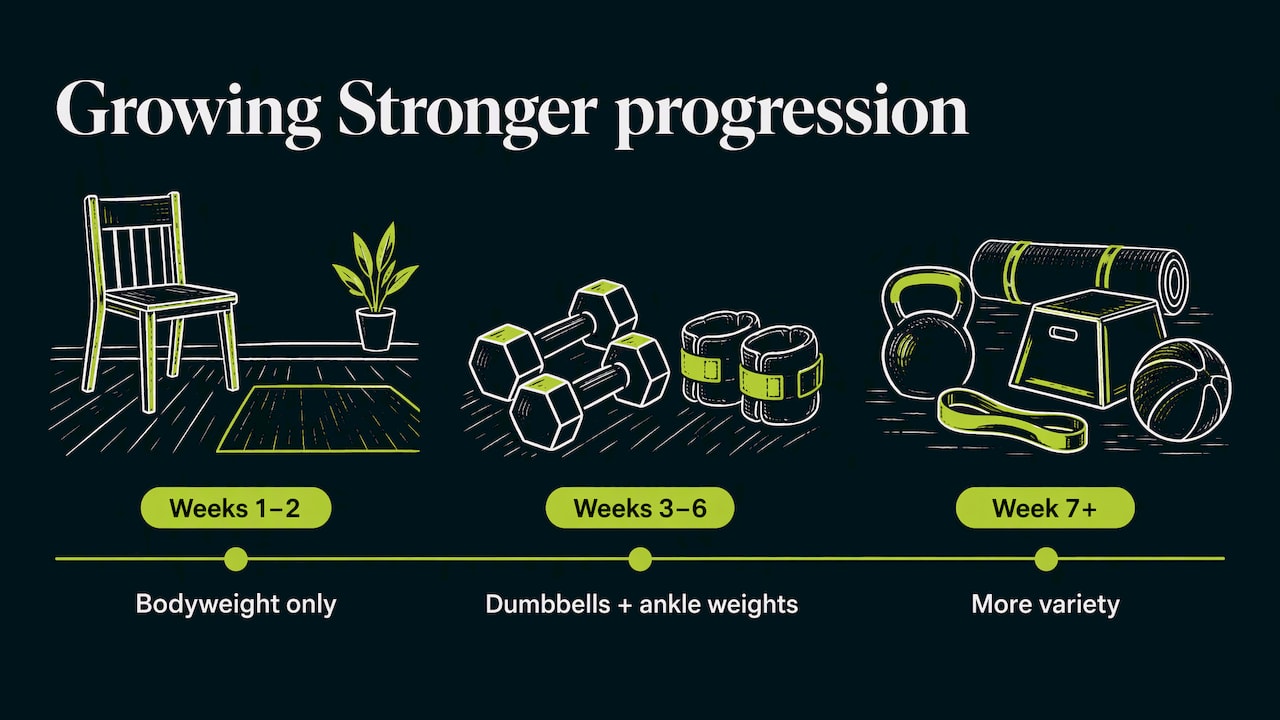
The CDC and Tufts Growing Stronger program shows how gradual this can be: bodyweight only in weeks 1 and 2, dumbbells and ankle weights added in weeks 3 to 6, more variety from week 7, two to three times a week with sets of 10. A review by Nelson and colleagues advises 8 to 10 exercises on two or more nonconsecutive days, with a weight that allows 10 to 15 repetitions.
The ACSM also notes that fall and fracture risk is more closely tied to losing muscular power than to losing strength, so older lifters may benefit from moving the weight with intent. Our Legends program is our 60-and-over class for exactly this.
How to progress without overreaching
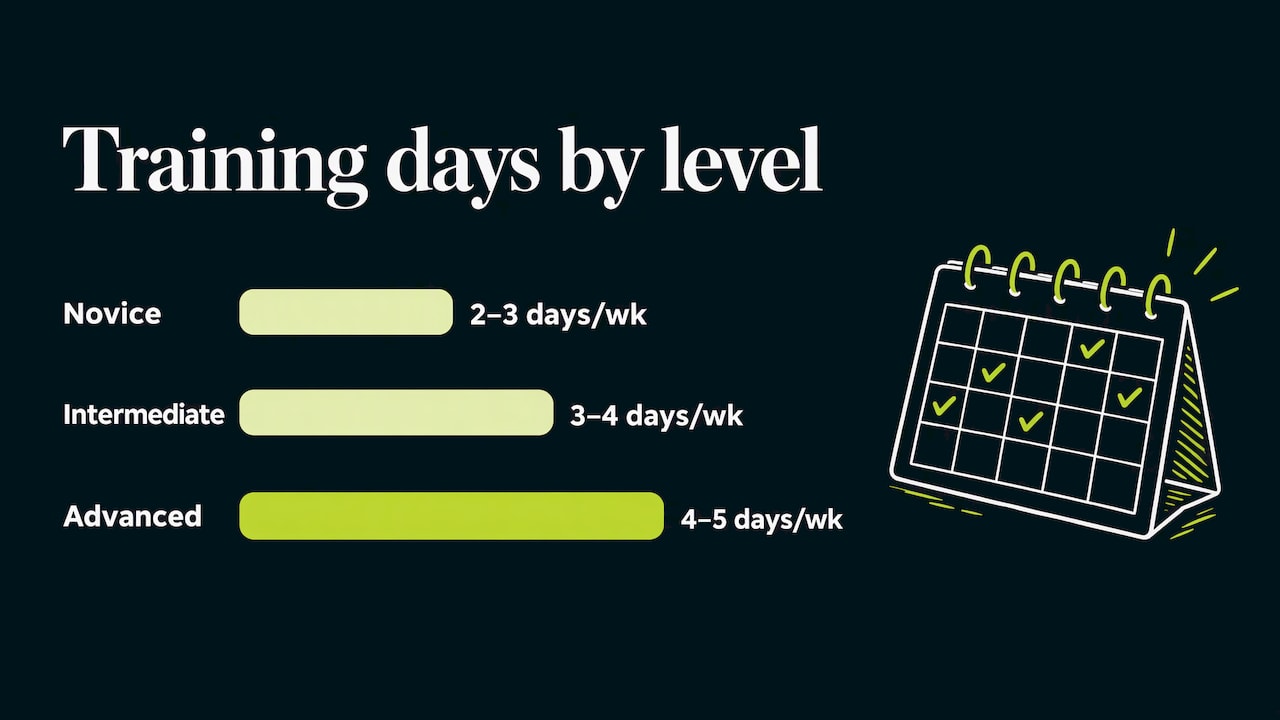
The ACSM’s 2009 progression position stand gives a clear rule: when you can complete one or two repetitions more than your target at the current weight, increase the load by 2 to 10%. Novices train two to three days a week at 8 to 12 repetition-maximum loads. Intermediate trainees move to three to four days and advanced trainees to four to five.
In practice:
- Pick a weight where the last two reps of your target are hard but clean.
- Repeat that weight each session until the top of your rep range feels easy.
- Add a small amount, and expect the reps to drop for a session or two.
- Take an easier week when you are run down, sick or sleeping badly.
Staying consistent matters as much as the numbers. ACE’s programming team notes that planned recovery between sets and sessions is what allows continued progress, and that stopping a program for as little as a month reduces training adaptations in markers such as blood pressure and cholesterol.
Safety checks before you begin
For most healthy adults, strength training is a standard recommendation. Still, a few situations call for a conversation with your doctor or physical therapist first. Harvard Health lists heart disease, asthma, high blood pressure, joint or bone disease, a neurologic illness and diabetes. It also names signs to stop and call a doctor: chest discomfort, wheezing lasting more than five minutes, faintness, and bone or joint pain.
The CDC’s Growing Stronger guide adds reasons to hold off or check first: fever, much more fatigue than usual, a swollen or painful joint or muscle, new symptoms, chest pain, an irregular heartbeat or shortness of breath. After an illness, take a day or two off and come back with lighter weights. If you are returning after a long break, start where the beginner plan starts, not where you left off.
Full body or a split routine?
A split divides the body across days, for example upper and lower. For most people reading this, full body is the better start. A 2024 meta-analysis of 14 studies found split and full-body routines produce similar strength and muscle gains when weekly volume is equal. ACE’s guidance on split routines says full body two or three times a week is ideal for beginners and anyone training for general health, and that splits make sense once you reach a fourth training day.
So if you can fit in two or three sessions a week, full body is enough. It is also forgiving: miss a Wednesday and you have not skipped “leg day.”
Why a coached class beats a plan on your phone
The plan above is simple. Following it for six months is the hard part. Many people we talk to joined a big-box gym, trained alone for a few weeks, and quietly stopped, because no one noticed. A full-body plan only works if you show up twice a week for months.
A coached class takes care of the parts that sink solo training:
- Technique. A credentialed coach teaches each movement and corrects form as you lift.
- Scaling. The workout is adjusted to you, whether you are a first-timer, over 40, or 60 and older.
- Structure. Classes follow one progressive program, so you do not have to design sessions or guess what comes next.
- Accountability. Our coaches know you by name and follow up when you stop showing up.
This is also the answer for people wondering if CrossFit is too intense. Intensity is scaled to the person, and the first 90 days look like learning, not suffering. Our post on the first 90 days of CrossFit and strength training describes what to expect.
Start strength training at Odin CrossFit
Odin CrossFit is an official CrossFit affiliate in downtown Frederick, owned and coached by Allison and Jason Jachowski. We offer one-hour coached classes, skills classes, yoga, open gym, Legends for ages 60 and over, and nutrition and accountability coaching. Our site lists 12 coaches and a 5.0 rating across 228 Google reviews. You can see how our group CrossFit classes work, read about strength training in Frederick, or go straight to the membership options. If you want to try a class first, there is a drop-in option.

If food is the missing piece, our nutrition coaching pairs habits and accountability with your training. Employers can ask about corporate wellness sessions on the same programs page.
Our view on full-body strength
We built Odin around a simple idea: strength is for everyone, and people stick with it when someone knows their name.
Full-body training is the right foundation because it respects real lives. Two or three sessions a week is realistic for a busy downtown professional, a new mom, a former soccer player who misses a team, or a member of our 60-and-over Legends group. Every class follows one progressive program, and every workout is scaled to the person doing it. The same squat, hinge, push and pull show up for everyone, at the load and range of motion that suits them.
The coach is the difference. A credentialed coach teaches the movement, corrects your form and decides when it is time to add weight. And when you miss a class, we notice. That is what keeps a plan going past week three.
Stay humble, live healthy, be happy.
Jason Jachowski
FAQ
How many days a week should I do full-body strength training?
Two to three nonconsecutive days is the standard recommendation for beginners. The Physical Activity Guidelines for Americans set two days a week as the minimum for all major muscle groups. Leave at least 48 hours before working the same muscles again.
Is full-body strength training safe for beginners over 40?
Yes, when you start light, learn the movements first and build up gradually. Older adults can begin with lighter resistance and more repetitions, and one set can be enough at first. If you have heart disease, high blood pressure, diabetes or joint problems, talk with your doctor before starting.
How long should a full-body workout take?
About 45 minutes to an hour, including a 5 to 10 minute warm-up and 2 to 3 minutes of rest between hard sets. Our coached classes run one hour.
Do I need a gym, or can I do this at home?
Bodyweight and dumbbells cover the basics. A gym adds heavier barbells, racks and space for carries. A coached gym adds someone who watches your form and adjusts your loads as you improve.
Sources
- Strength training basics, Mayo Clinic
- Strength training: Get stronger, leaner, healthier, Mayo Clinic
- Designing a Well-Rounded Resistance Training Program, Adelphi University
- NSCA Personal Training Quarterly, Issue 10.2
- Strength Training Basics, The Whole U, University of Washington
- Strength Exercises and Weight Training, American Cancer Society
- Physical Activity Guidelines for Americans, 2nd edition
- ACSM position stand, Exercise for Developing and Maintaining Fitness (2011)
- ACSM position stand on progression models in resistance training (2009)
- The Benefits of Strength Training, New Mexico State University
- Growing Stronger: Strength Training for Older Adults, CDC
- Physical Activity and Public Health in Older Adults, ACSM/AHA
- Strength and Power Training: A guide for older adults, Harvard Health
- MOVE! Physical Activity Handout P32, VA
- Efficacy of Split Versus Full-Body Resistance Training, meta-analysis (2024)
- Mastering the Art of the Split Routine, ACE
Recommended
Start with a free intro
A chat with a coach, a tour of the gym, or a first class. Whichever fits you.